Species: Llecta intractata
Hodges: 6711
Flight Period: April - September
Wing Span: 21-31mm
Peterson: 225;
Hosts: American Holly
Field Notes: Any creature that can make its living on American Holly (Ilex opaca) has my respect. The leaves are waxy and tough and the berries are poisonous to most animals. Holly is an early successional small tree, some say large shrub, that persists in the understory as a forest ages. In Troy Meadows American Holly is scattered here and there throughout the uplands as a remnant of late-stage early succession. Tethered with this beautiful plant is the black-dotted ruddy whose larvae is somehow able to graze on its leaves. Specialized relationships like these are a fascinating aspect of the ecology of Troy Meadows. The image to your left was taken in the north-end of the Meadows August 24th 2013.
Ruddy - Rosy red healthy color
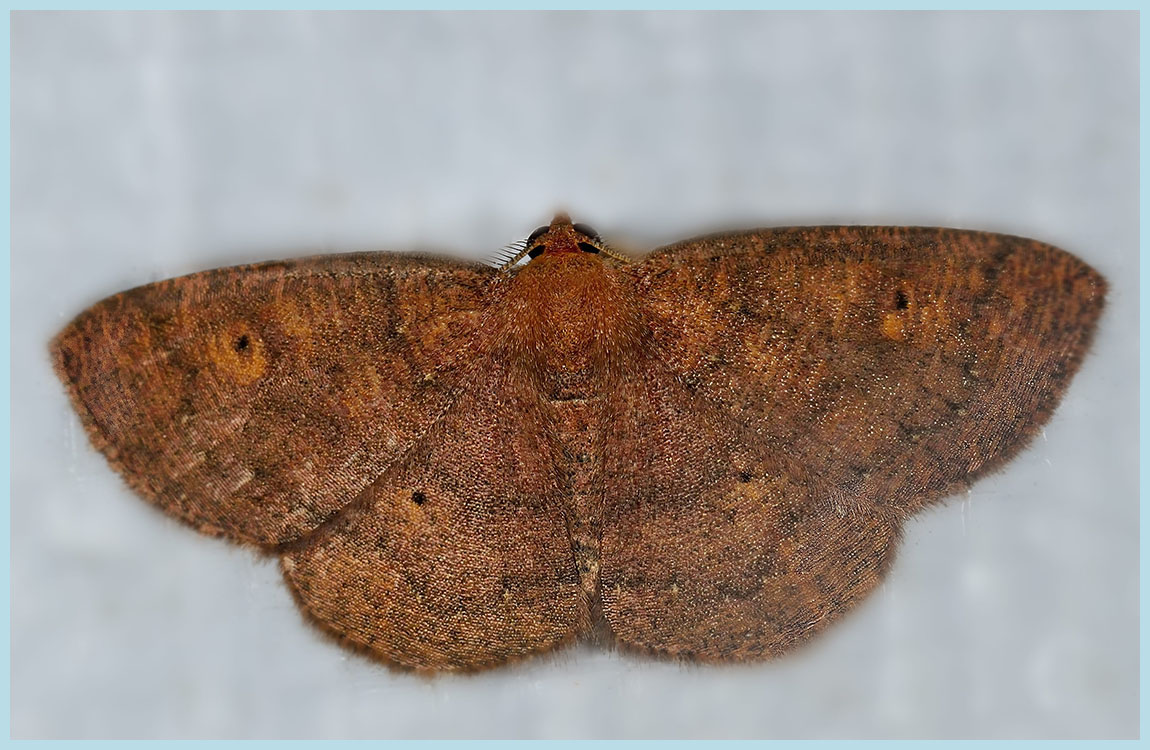
Dorsal View
Species: Isa textula
Hodges: 4669
Flight Period: April - Early Septembe
Length: 10-15mm
Peterson: 73
Hosts: Ironwood , Hickory, Oa
Field Notes: The geometry of Slug Moths is unmistakable but the differences between species is sometimes unnerving. In the case of the shagreened there is enough specific pattern and color that this elegantly painted Apoda is fairly easy to distinguish amongst its brethren. Specifically, look at that diagnostic chestnut patch at the apex and anal angle - these two marks should help you "close the deal". The word shagreen refers to untanned leather with a granular surface; in biology it refers to rough scales or points - I suppose that the American entomologist, Alpheus Spring Packard Jr. who described the moth in 1864 looked at the adult form and felt it looked rough enough to warrant this name. Three other members belonging to the slug moth family, Limacodidae, were noted during our inventory of the Meadows: Skiff Moth (Promlicodes badia), Purple-crested Slug Moth (Adoneta spinuloides), and Crowned Slug Moth (Isa textula). Eventually these will be added as future plates, so check back often!

and Summer Quakers
Tribe: Eriopygini
Species: Lacinipolia explicata
Hodges: 10413
Flight Period: May - September
Length: 15-17mm
Peterson: 501
Hosts: Lawn forbs, lettuce, and clover
Field Notes: Surprisingly this moth was only first discovered in southern New Jersey in 1998. I say surprisingly because it is very common during the peak of its flight period in August. During this time at the Meadows you will undoubtedly attract this moth in small numbers to your lights. The intricate detail of this moths integument looks as though its been painted by an artists with a very still hand. The drab brown caterpillar can feign death often sitting dead-still for over 30 minutes before feeling brave enough to reanimate.
and Summer Quakers
Tribe: Eriopygini
Species: Lacinipolia renigera
Hodges: 10397
Flight Period: May - Early October
Length: 14-15mm
Peterson: 501
Hosts: Crops and low plants
Field Notes: With two or more broods it's no wonder why we've seen this moth on more than one survey night out at the Meadows. The common name does not refer to the adult, but is a reference to the caterpillar whose body is covered in spine-like setae. Besides a whole host of low growing forbs, the larvae of this species can eat dead leaves. This habit may be reserved for the last generation about to overwinter belowground in a cocoon spun with debris, rotten wood, and shredded leaf litter. Because the larvae feed near the soil surface it has gained a secondary common name "Groundcat". Interesting fact: When alarmed this species can withdraw its head, turtle-like, into its thorax.
Species: Lacosoma chiridota
Hodges: 7659
Flight Period: April - October
Wing Span: 20-30mm
Peterson: 231
Hosts: Oaks
Field Notes: The new Peterson Guide to to Moths (2012, Beadle & Leckie) claims that this species is uncommon in the northeast. This we've found to be untrue. By no means would I claim it to be ubiquitous, but it has shown up on more than one occasion during state-wide field surveys. This new field guide is an excellent aid for identifying most of the common and some uncommon moths in the northeast. However we would caution that many errors have been found to prevalent, so remember to use many sources when "keying" out your specimen. In the case of this moth the scalloped-wings make it virtually impossible to misidentify. The scalloped sack-bearer is a specialist of oaks in the larval stage. They call this moth and other members of Mimalloniidae family sack-bearers because their larvae build open-ended sacks out of detritus and leaves to overwinter and pupate. Just another example of the many strategies moths use to make a living.
Species: Lascoria ambigualis
Species: Ledaea perditalis
Tribe: Leucaniini
Species: Leucania inermis
Hodges: 10459
Flight Period: June - Mid September
Length: 17mm
Peterson: 497
Hosts: Orchard Grass
Field Notes: Those two rows of post medial dots seem to be diagnostic. Also notice that this wainscot has a squabby overall shape to it. Inermis in Latin means harmless or unarmed. The unarmed wainscot is a specialist larvae feeder on Orchard Grass (Dactylus glomerata) but is not considered a pest of agriculture as far literature states. Like most member of the Tribe Leucaniini the larvae have large mandibles. As a grass feeder the mandibles require great ripping and shredding power. In the Meadows we have come to expect it to bless our presence sometime in August. Because of its drab, earthy garb, it just seems to appear out of nowhere. Most of us are looking for the colorful moths as our minds-eye tends to ignore the mundane at the expense of subtle beauty and more intricate fascinations.
Tribe: Noctuini
Species: Leucania linda
Hodges: 10445
Flight Period: Mid June - Early October
Length: 20-21mm
Peterson: 495
Hosts: Grasses
Field Notes: If conditions are right, like many species in the tribe Leucaniini this moth has a relatively long potential flight period allowing for the possibility of a second brood. Franclemont (1952) who described the moth may have had a close relationship with a women named Linda may explain the common name of this moth, though no evidence exists to support the notion. The moth looks very similar to the Phragmites Wainscot (Leucania phragmitidicola) but upon expert examination of the image to your right the species is identified as linda mainly because the forewings are tinted reddish brown. The two are extremely close in size and appearance and secondary characteristics and larval examination are warranted for positive identification. Because we haven't captured, killed, and vouchered specimens the image to your right will remain as "likely" to be Leucania linda. This plate is therefore an example of the tradeoff between image identification and that performed by experts postmortem. This species is known to double brood (bivoltine), and likely why we've seen it in early May and again in June.
Tribe: Leucaniini
Species: Leucania ursula
Hodges: 10461
Flight Period: April - October
Length: 19mm
Peterson: 499
Hosts: Crabgrass and honeysuckle
Field Notes: The moth to your right was found on August 30th, 2013. Like many in the tribe Leucaniini these moths can be flying in all seasons except winter. Dale Schweitzer, a well known moth expert, once saw the larvae feeding on dandelion in the wild. This could be common host plant. Crabgrass and honeysuckle are the host plants noted in the literature. Troy Meadows is a mosaic of habitats dominated by open marsh, interfaced with floodplain, wet woods, meadows, and uplands. The forementioned larval host plants are disturbed site and edge species likely responsible for the moths presence. With this many sub-habitat types dispersed about the landscape its no wonder that intricate cohabitants like L.ursula are tethered into the fabric.
